
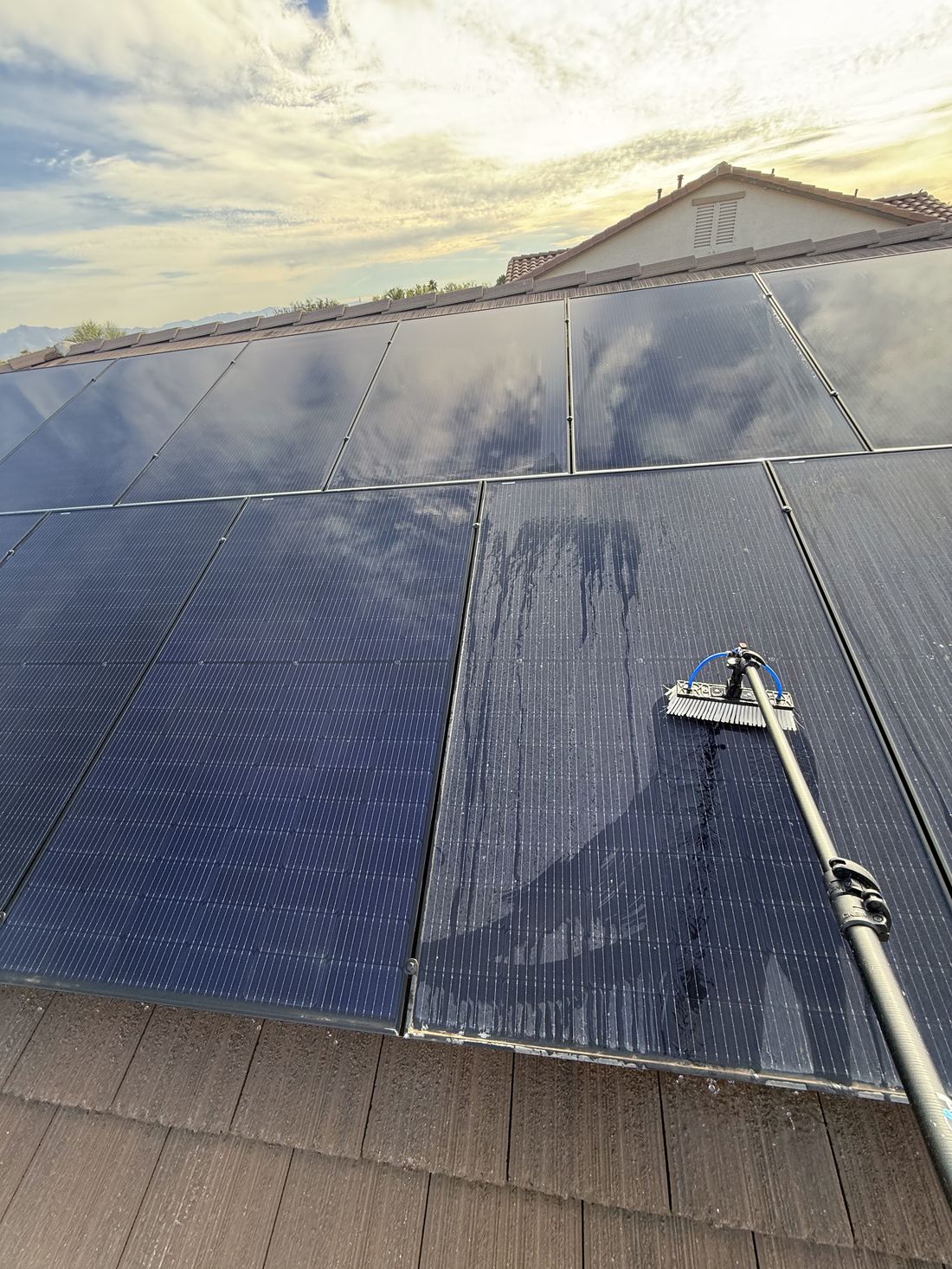
If you've invested in solar panels in Arizona, you've probably wondered how often cleaning is really necessary. The answer depends heavily on where in the Valley you live — and it's almost certainly more often than your installer told you.
As someone who cleans solar panels across Queen Creek, San Tan Valley, Gilbert, Mesa, Chandler and Tempe every week, I've tracked what different cleaning frequencies do to output numbers. Here's what the data and our experience actually show.
Why Arizona Is Different
Most online guides about solar panel cleaning are written for temperate climates with regular rainfall. Arizona is the opposite:
- Low rainfall — Phoenix averages just 8 inches per year. Rain naturally cleans panels elsewhere; here, it barely touches them.
- Fine desert dust — Arizona's PM10 particulate levels are among the highest in the country. Dust settles and bakes onto tilted glass in the summer heat.
- Monsoon film — July–September monsoons leave muddy deposits that are harder to remove than dry dust and significantly cut light transmission.
- Bird activity — Concentrated droppings from pigeons and doves create "hot spots" that reduce both output and panel lifespan.
⚡ Key finding: Studies show solar panels in dusty climates lose 5–35% output between cleanings. In Arizona's East Valley, we routinely measure 15–25% output restoration after a professional clean.
The Right Cleaning Schedule
Minimum: Twice Per Year
Clean once in spring (March–April) before peak production season, and once in fall (October–November) after monsoon season. This is the minimum for most East Valley homeowners and will prevent the worst efficiency losses.
Better: Quarterly
For homes in Queen Creek, San Tan Valley and Gilbert — especially with south or west-facing arrays — quarterly cleaning delivers meaningfully better ROI. You'll see a consistent 10–15% production improvement over twice-yearly, and each individual clean is easier with less buildup per visit.
Maximum Output: Monthly or Bi-Monthly
Commercial arrays, homes with pigeon problems, or properties adjacent to agricultural land benefit from more frequent cleaning. If your monitoring app shows output declining noticeably within 4–6 weeks of a clean, you're in this category.
How to Tell if Your Panels Need Cleaning Now
- Check your monitoring app — A 10%+ drop compared to the same period last year is a strong soiling signal.
- Visual inspection from the ground — Visible dust film, bird droppings, or a yellow/tan tint to the glass.
- After any dust storm — Arizona haboobs deposit fine particles even when you can't see them. Clean within a week of a major event.
- After monsoon season ends — First rains often make soiling worse by mixing dust into muddy film. Schedule a post-monsoon clean in October.
💧 Important: Never use tap water to clean solar panels yourself. Arizona's extremely hard water leaves white mineral deposits when it dries — worse than the dust you started with. Professional cleaning uses purified, deionized water that leaves zero residue.
The Bottom Line
In Arizona, twice a year is the minimum, quarterly is the sweet spot for most homeowners. If you're in a high-dust area or dealing with pigeons, go more frequent — or consider adding pigeon proofing to protect the investment permanently.
The math usually works in your favor: if your array generates $200/month and a clean restores 20% output, each visit pays for itself within weeks in recovered production.